The 8th House: The Shadow Within
The 8th House: The Shadow Within – A Journey into the Hidden Self "The greatest battle in life is not against...
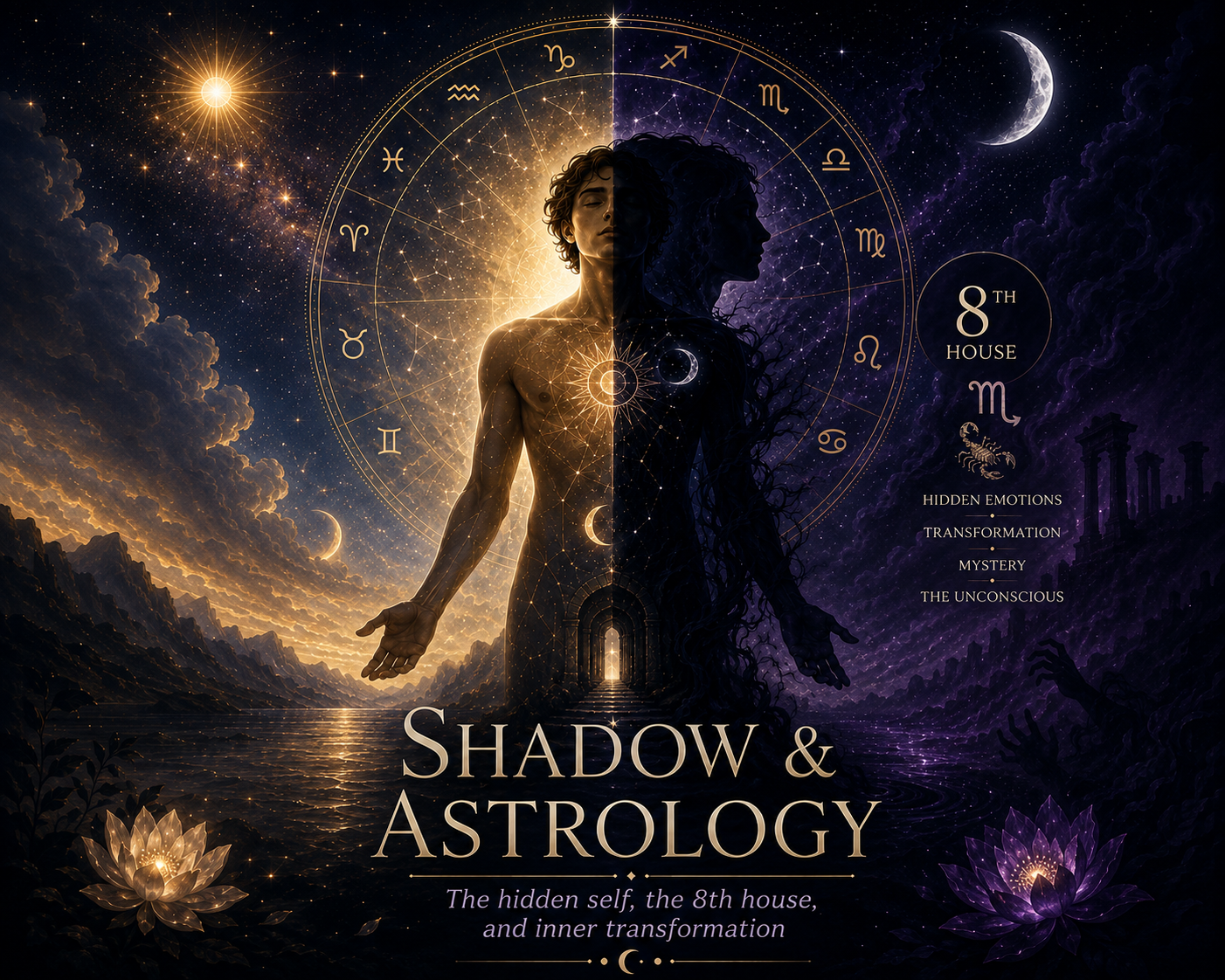
"The greatest battle in life is not against the world, but against the unconscious forces within us."
The 8th house has always been considered one of the most mysterious houses in astrology. It is associated with transformation, death and rebirth, hidden knowledge, occult sciences, inheritance, deep psychology, and the unseen consequences of our actions.
Many astrologers also view the 8th house as symbolizing the unconscious mind—the part of ourselves that silently influences our behavior without our awareness. While this is an astrological interpretation rather than a psychological fact, it creates an interesting parallel with the ideas of Swiss psychologist Carl Gustav Jung, who described the Shadow as the hidden part of the human psyche.
When these two perspectives are explored together, they offer a powerful framework for self-reflection and inner growth.
Most people become interested in the 8th house because they hear it represents:
While these themes appear in traditional astrology, they represent only one layer of the symbolism.
At a deeper level, the 8th house asks a more important question:
"What inside you must die so that a wiser version of you can be born?"
The real death represented by the 8th house is often the death of false identity, unhealthy attachments, ego, fear, ignorance, and unconscious conditioning. Every spiritual tradition speaks of this inner death before enlightenment.
Carl Jung believed that every human being has two personalities.
The first is the personality we proudly show to society. The second is the personality we hide—even from ourselves.
This hidden personality is called the Shadow.
The shadow contains everything we reject:
Many people think spirituality means becoming positive. Jung suggested something different. He believed true growth begins by recognizing what we have hidden—not pretending it does not exist.
Suppose a child grows up in a family where crying is considered weakness. Every time the child cries, he is told, "Be strong." Eventually he stops crying.
Most people think the sadness has disappeared. It has not. It has simply moved into the unconscious.
Years later the same person develops:
The original emotion never disappeared. It simply changed its form.
Jung argued that whatever we refuse to face eventually begins directing our lives from the unconscious. This echoes his famous observation:
"Until you make the unconscious conscious, it will direct your life and you will call it fate."
Many astrologers see the 8th house as symbolizing those hidden psychological and emotional layers.
From this perspective, planets placed in the 8th house may represent areas of life where transformation, intense emotional work, or confrontation with hidden patterns is emphasized.
For example:
These interpretations are symbolic and should be understood as tools for self-reflection rather than fixed predictions.
Many people think karma simply means: "I did something bad in a previous life."
The Vedic understanding is broader.
Karma is not only external events. It also includes:
These are called Samskaras—mental impressions formed by repeated thoughts, emotions, and actions. Every repeated experience leaves an imprint on the mind. That imprint influences future thoughts and choices.
Imagine your mind as soft clay. Every thought leaves a footprint.
One angry thought changes very little. But thousands of angry thoughts create a deep pathway. Eventually anger becomes automatic.
The same is true for:
These repeated impressions become part of our conditioning. Whether viewed through the language of psychology or spirituality, the basic insight is similar: repeated mental patterns shape future behavior.
Meditation is often misunderstood. Many believe meditation is about stopping thoughts.
In reality, meditation first helps us observe them. When we become aware of a thought without immediately reacting, we weaken its unconscious control over us.
Instead of becoming our thoughts, we become the observer of our thoughts. This shift—from identification to observation—is central in many contemplative traditions.
One of Jung's most influential ideas is projection.
We often criticize in others the qualities we have not accepted in ourselves.
For example:
Projection is not proof that every criticism reflects our own shadow, but it can be a valuable question to ask ourselves. Recognizing these patterns can lead to greater self-awareness and healthier relationships.
The purpose of the 8th house is not punishment. Its purpose is transformation.
In Hindu philosophy, Shiva is often associated with transformation—not because He destroys life, but because He destroys ignorance.
Similarly, the symbolic journey of the 8th house is one of letting old identities dissolve so that greater wisdom can emerge.
Healing does not begin with rituals alone. It begins with honesty.
Observe: Notice recurring emotional reactions.
Accept: Acceptance does not mean approval. It means acknowledging reality without denial.
Understand: Ask: "What is this emotion trying to teach me?"
Transform: Use meditation, self-inquiry, prayer, mantra, seva (selfless service), forgiveness, and conscious living.
Over time these practices can help reshape habitual patterns and cultivate greater inner freedom.
Many fear the 8th house because they associate it with suffering. But suffering itself is often the beginning of awakening.
Some of life's deepest transformations arise after experiences such as:
These experiences can force us to question who we are and what truly matters.
The 8th house reminds us that while we cannot always control what happens to us, we can grow through how we respond.
The 8th house is not simply the house of death—it is the house of rebirth.
It invites us to explore the hidden corners of our own mind, to recognize unconscious patterns, and to transform fear into wisdom.
Whether you approach this through astrology, Jungian psychology, meditation, or spiritual practice, the underlying invitation is the same:
Become conscious of what has been unconscious. Only then can you begin to respond freely rather than react automatically.
"The greatest mystery of the 8th house is not death. It is the transformation that becomes possible when we stop running from our own shadow and allow awareness to illuminate what was once hidden."
The 8th House: The Shadow Within – A Journey into the Hidden Self "The greatest battle in life is not against...

Birth Chart Consultation: Discover the Deeper Meaning of Your Kundali Every individual is born with a unique combination of planetary energies....

Gemstones and Divinity : Ancient Wisdom, Planetary Connections and Vedic Astrology Gemstones and their relation with destiny have remained fascinating among...

Vedic jyotish, as the name suggests, has a connection with the Vedas or the Vedic period, which is also called...

Your rising sign, also known as the ascendant, is the zodiac sign that was ascending on the eastern horizon at...

The astrological chart is divided into twelve houses, each representing a different sphere of life—from personal identity and relationships to...

Mercury retrograde is one of the most well-known astrological phenomena, often associated with miscommunication, technology glitches, and travel disruptions. During...

Astrology, an ancient practice rooted in the observation of celestial patterns, offers a fascinating lens through which we can better...

Astrology offers a fascinating lens through which to explore human personality and relationships. Each zodiac sign carries distinct traits that...

While the sun sign often takes center stage, the moon's influence in astrology is profound and deeply personal. The moon...